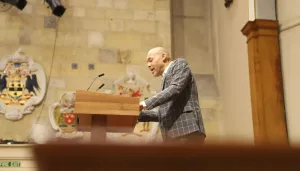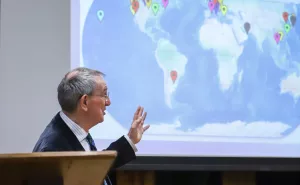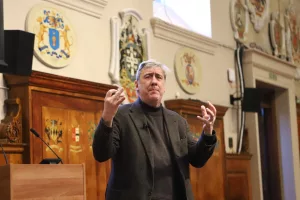
Celebrated polyglot Richard Simcott hits home the importance of languages, revealing to Westminster pupils the brilliance and interconnectedness of the spoken and written word.
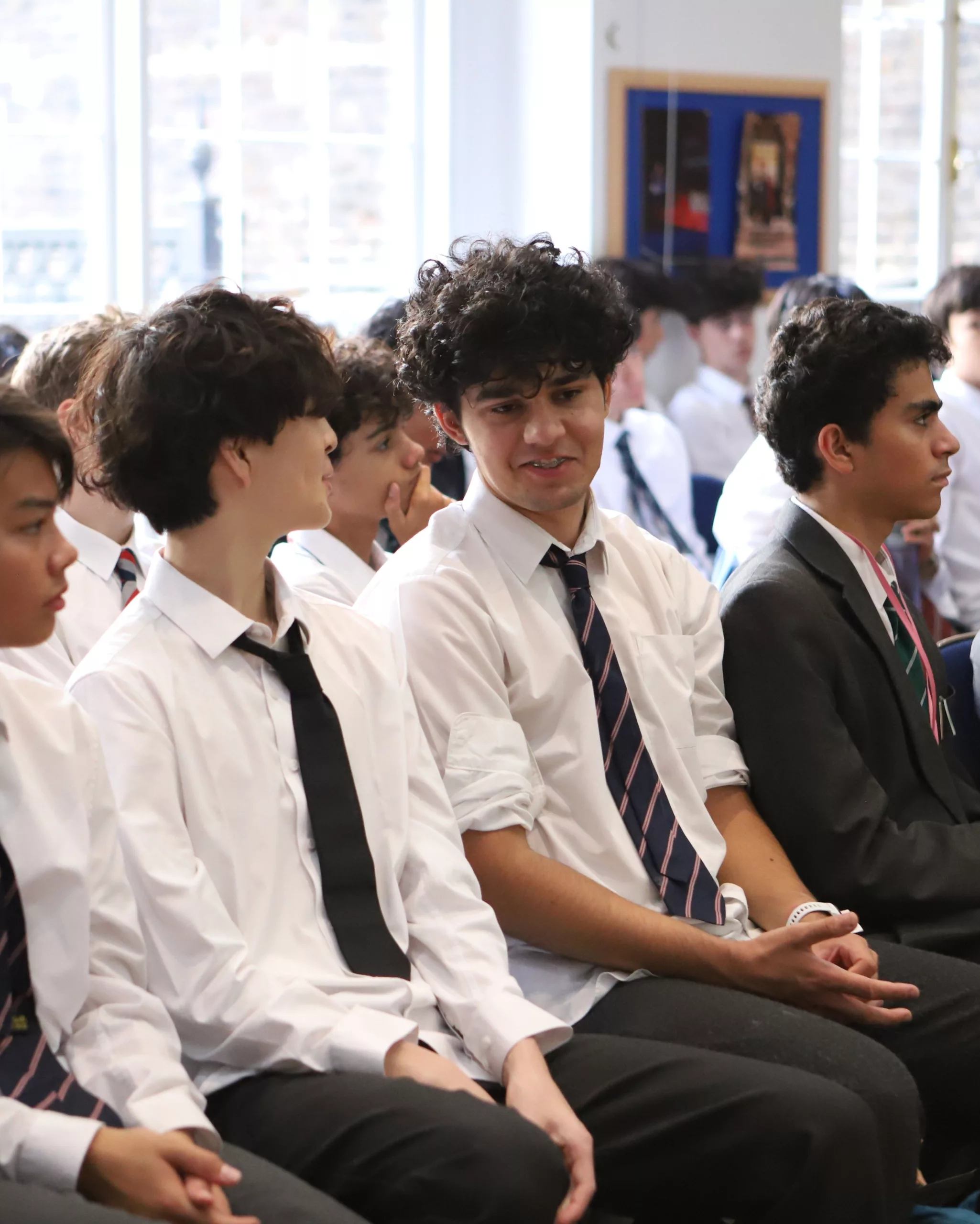
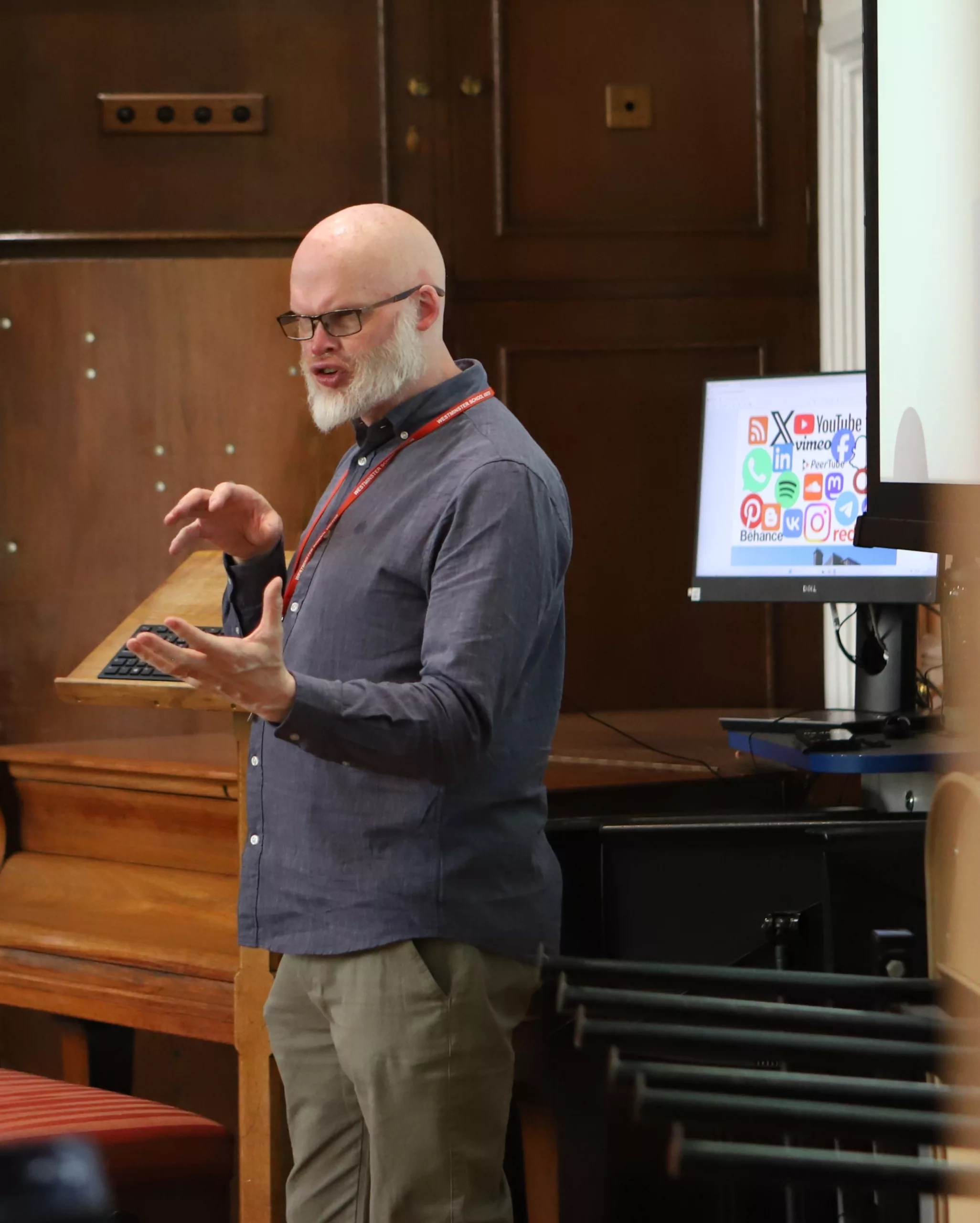
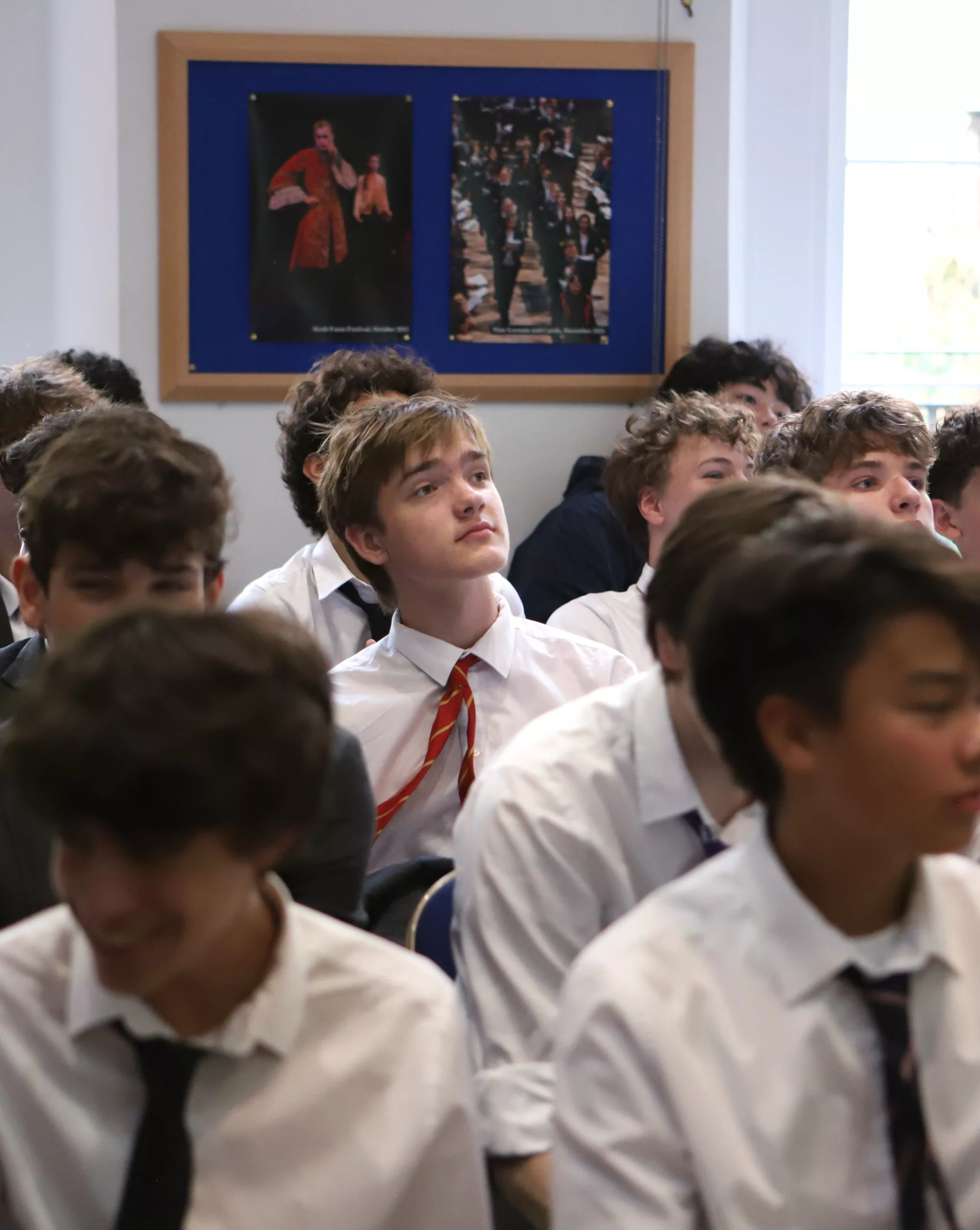
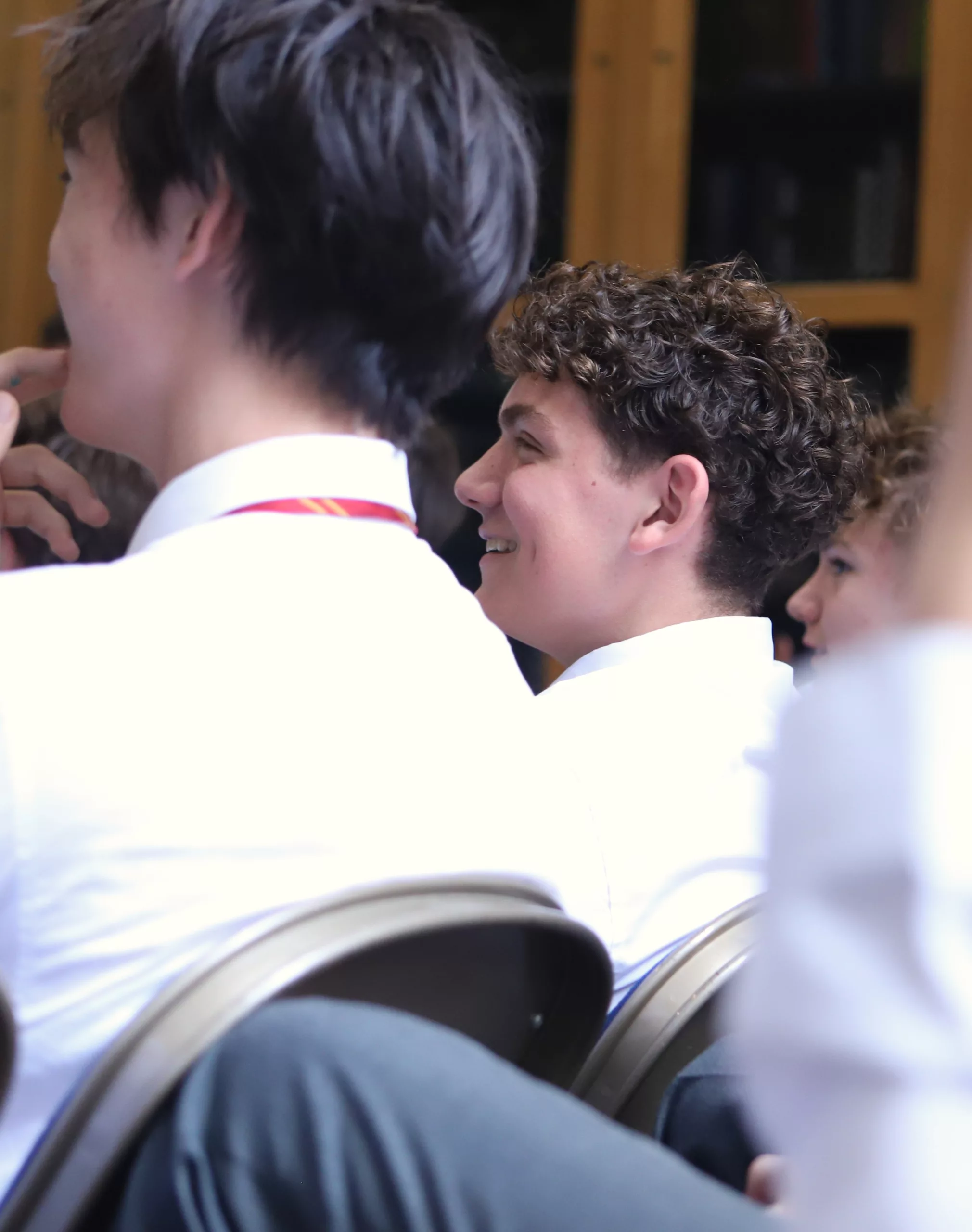
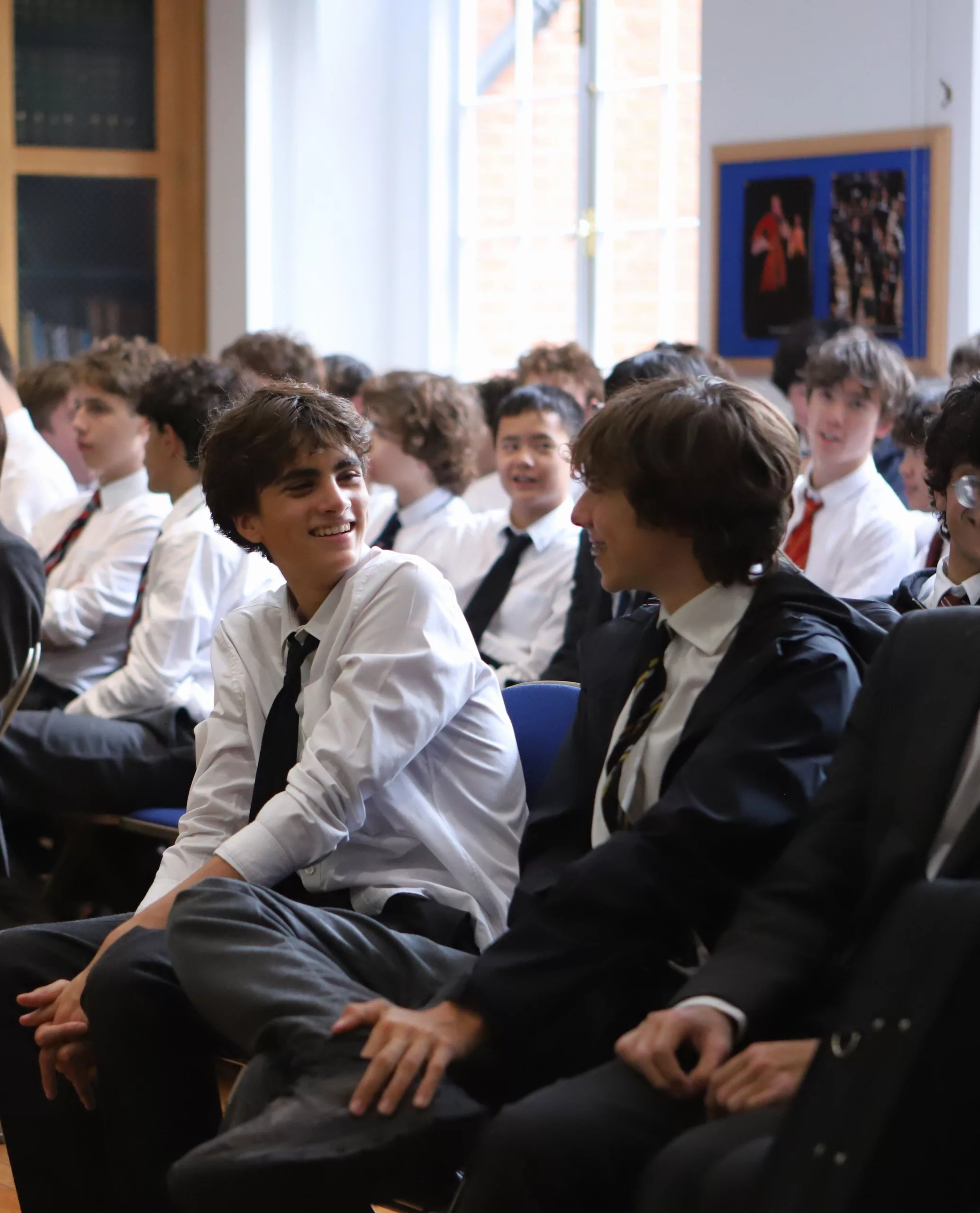
In his talk to Year 11 pupils, Richard Simcott sparked much discussion regarding the roots of words, throwing in quirky idioms and demonstrating the performative charm of language by effortlessly slipping into different accents, including a very convincing Scouse.
Richard presented the terms ‘language’, ‘dialect’ and ‘idiolect’ to the group, eliciting a pupil analogy comparing dialect to the coronavirus, with its ever-changing variants and mutations, and prompting a narrative around how languages evolve over time. He explained that during lockdown, he focused his language learning closer to home, engaging with regional languages such as those of the Channel Islands. Similarly, Brexit in 2016 altered the opportunities available for intensive language learning abroad.
Expanding on the question of what separates a language from a dialect, he displayed Max Weinreich’s famous quote: “A language is a dialect with an army and a navy”, which he had translated from Yiddish into English. He used it to illustrate the idea that languages often attain their status through common and widespread usage.
Drawing on his Welsh heritage and the idea of ‘rebracketing’, he gave the example of ‘neidr’, meaning snake in Welsh, comparing it to ‘adder’ in English. In Old and Middle English, the word for snake was ‘naddre’ but, over time, driven by euphony (‘good sound’), it shifted from ‘a naddre’ to ‘an adder’ as we know it today. Similarly, he offered the word ‘ken’ to the group, asking whether anyone knew its meaning. A pupil responded that in Scottish dialect it means to know or understand, and Richard drew on the connection with the German verb ‘kennen’ (to know or be familiar with), explaining that ken has deep Germanic origins and derives from the Old English word ‘cennan’ and the Old Norse ‘kenna’.
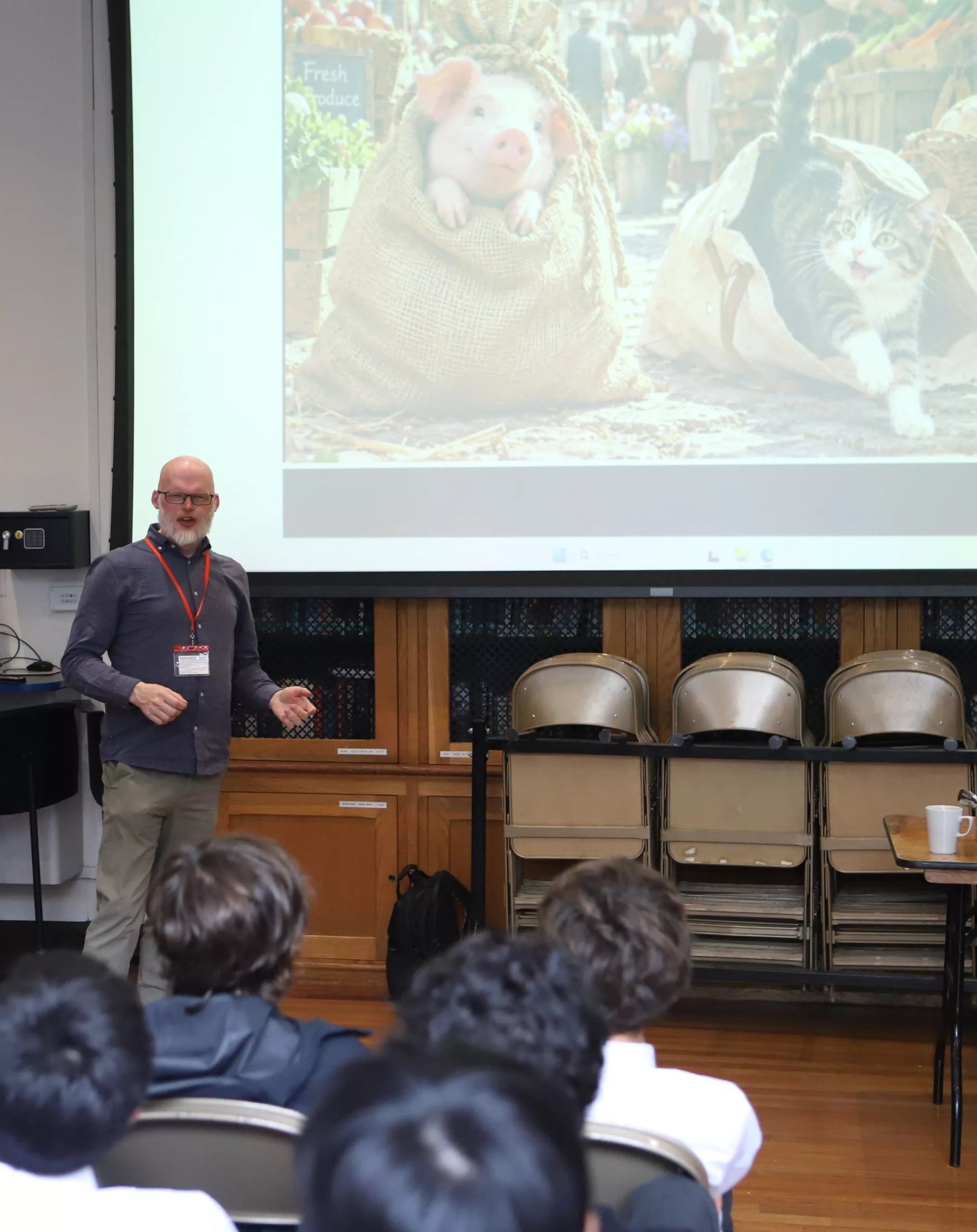
The audience was particularly taken by the juxtaposed images of a pig and a cat in bags, representing two well-known idioms. After projecting the Old French word ‘poque’ on the screen, meaning ‘small bag’, Richard introduced its Old English derivative, ‘poke’. Centuries ago, it was not uncommon for a farmer to trick a buyer into purchasing a feral cat instead of an expensive suckling pig. Hence the phrase “a pig in a poke”. A sensible shopper, however, would ‘let the cat out of the bag’ and realise they had been scammed.
When Richard concluded his exploration into the beauty of language and the fun that can be had with it, many pupils had questions for him. One asked what had motivated him to study so many languages, to which he responded: “Languages are like sudoku puzzles in my head. It’s fascinating how they interconnect.”
Richard speaks more than 30 languages, including Ancient Greek, Dutch, Macedonian, Russian, Serbian, Spanish, Turkish, and Thai, and can read five scripts, including Arabic and Hebrew. He continues to study more languages and is currently learning Hindi, Korean and Scots, among others. Recently he learned Cornish ‘Kernewek’ by engaging in a language-swap. He is an ambassador for multilingualism and the founder of the International Polyglot Conference. He spent his day at Westminster in conversations with Sixth Formers hoping to study languages at university as well as pupils in other year groups.
Languages at Westminster continue to thrive. Year on year the School supports pupils’ involvement in Classics Olympiads and French debating competitions, and pupils have the opportunity to take part in German and French language exchanges and trips to Spain. GCSE Russian learners can attend an immersive language expedition to Georgia, and those wanting to learn Arabic, Japanese, Italian or Modern Greek can do so as part of the co-curricular timetable. The pupil-led Linguistics Society is hugely popular, and pupils produce and perform an annual bilingual play, managing the translations for the surtitles themselves. Classics, French, German, Spanish and Russian are taught at GCSE and beyond, and Chinese is available at A Level. Many go on to study languages at top universities worldwide, combined with Law ahttps://www.westminster.org.uk/westminster-school/co-curricular-life/expeditions-and-exchanges/nd other disciplines.
Following the talk, Rayan (Upper Shell, CC) said: “To learn of both the journey and true talent of Mr Simcott is awe-inspiring, and I really enjoyed being shown some of the linguistic connections and evolution that I had never noticed, despite it all hiding in plain sight for so many years!”
Adam (Upper Shell, PP) said: “It seemed to me that Richard, as well as speaking over 30 languages (fluently!), was a skilled public speaker. Through effective presentation, his humble, matter-of-fact tone, and his readiness to answer any question posed to him, he managed to spark curiosity, and engage the attention of us students.”
Gavin (Upper Shell, WW) said: “Yesterday, we met someone who is hailed as one of the greatest hyperpolygots in Britain by the Guardian, Richard Simcott. He told us his story, and his journey into developing a lifelong enthusiasm to learn languages. Explaining to us how he sees words in many languages, he taught us the difference between dialects, accents and languages, and in an engaging way communicated to us the etymology of words. Having a few minutes left, students asked some questions which he responded to in an expressive way. Overall, it was a very enjoyable experience.”
Theo (Upper Shell, GG) said: “Richard was an engaging and talented speaker. During the course of the talk, I learnt a multitude of different things about language learning, and was inspired by his motivation and dedication to the skill. He taught us that there’s more to language than vocabulary and grammar, and how different languages and dialects open up many cultural opportunities.”