History, Archives and Collections

Westminster School Crest

Our History

Westminster is an ancient boarding and day school with a unique sense of place. It is, in fact, the only long-established school to remain on its original site in the centre of London. The School’s origins can be traced to a charity school established by the Benedictine monks of Westminster Abbey. Its continuous existence is certain from the early fourteenth century.

After the dissolution of the monasteries in 1540, Henry VIII personally ensured the School’s survival by statute. Elizabeth I, confirmed royal patronage in 1560 and is celebrated as the School’s Founder. For several hundred years, the School continued to be joined with Westminster Abbey, forming one collegiate foundation, until the 1868 Public Schools Act established the school as an independent body. The School still enjoys a close relationship with the Abbey and the Dean of Westminster is an ex officio member of the School’s Governing Body.

In 1943 the School expanded its educational scope by forming Westminster Under School, educating boys from the age of 7. Initially both sections of the School shared a site, the Under School beginning with just 17 boys, until 1953 when it secured its new premises in Eccleston Square. Meanwhile, in 1973 Westminster School expanded its scope, admitting girls as full members of the School at 16+. In 1981, the Under School moved once again to Adrian House, overlooking Vincent Square, and expanded in 2011 to include George House.

From September 2026, boys and girls will be entering the Under School’s brand-new Pre-Prep at 4+, while girls will also be joining boys at 7+ and 11+, and from September 2028 girls will be joining us at 13+. By 2030, Westminster Under School and Westminster School will have become fully coeducational, with boys and girls in every year group from age four until 18. As part of this process, Westminster Under School has acquired Chapter House and Westminster School, 11 Tufton Street.

1394

Abbey Account Rolls record payments to the ‘magistro scolarum pro erudicione puerorum’ [‘School master for the education of children’].
1461

The School moves from the Almonry to Dean’s Yard.

1540

The Benedictine monastery is dissolved but Henry VIII ensures the survival of the School.

1560

Following the brief restoration of the monastery under Mary I, Elizabeth I issues a new charter to ‘The College of St Peter at Westminster’.

1562

First Election Dinner following the Election of scholars to Trinity College Cambridge and Christ Church Oxford.

1564

Elizabeth I attends the annual Latin Play.

1599

The former mocks’ dormitory is first used as a school room.

1638

Richard Busby becomes Head Master, remaining in post until his death in 1695.

1649

Execution of Charles I. Busby leads the School in prayers for the King on the day of his beheading.

1659-65

The Busby Library and Ashburnham House are built.

1666

Fire of London. Dean Dolben and the Scholars save St Dunstan’s in the East.

1685

Westminster boys first formally attend a Coronation.

1731

The Scholars move into the new dormitory designed by Lord Burlington.

1746

First recorded cricket match: Old Westminsters vs Old Etonions.

1750

The Grant family begins to manage a boarding house.

1753

First recorded ‘Pancake Greaze’.

1796

First cricket match against Eton at Hounslow Heath.

1810

Vincent Square is secured as a playing field for the School by Dean Vincent.

1815

The Water ledger, recording rowing at the School, begins.

1855

Last wholly oral format of the Challenge (scholarship examination).

1858

Prince Albert and the Prince of Wales attend the Latin Play.

1868

The Public School Act gives Westminster independence form Westminster Abbey.

1881

Ashburnham House is purchased on the death of Lord John Thynne; a new day boy house (Ashburnham) is started.

1883

First non-classical curriculum.

1905 - 06

The School’s first science building is built in Great College Street.

1919

George V, Queen Mary, the Prince of Wales (later Edward VIII) and Prince Albert (later George VI) attend the Pancake Greaze.

1921

The School unveils its First World War memorial; 224 Old Westminsters are know to have died in the conflict.

1939

The School is evacuated due to the threat of air raids on London, eventually returning in 1945.

1940

The Head Master’s secretary, Ruth Mecey, is killed when a bomb falls on Church House. Five days later, the Busby Library is destroyed in another air raid.

1941

College and School are severely damaged in the air raid that also destroyed the House of Commons.

1943

The Under School is started in Dean’s Yard.

1953

Westminster Under School moves out of Dean’s Yard and into its own premises in Eccelston Square.

1973

Girls first become full members of the School.

1981

Westminster Under School moves out of Eccleston Square and into its current premises in Adrian House.

2001

Opening of the Millicent Fawcett Hall (the School’s theatre).

2005

Opening of the Manoukian Music Centre and the Weston Building.

2010

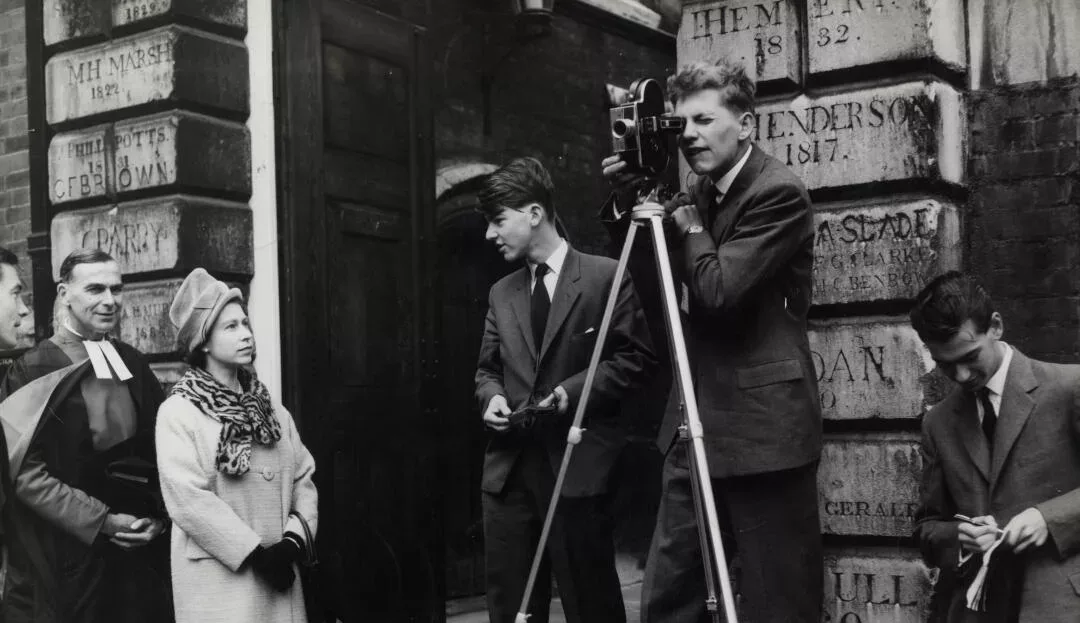
Queen Elizabeth II visits the School to celebrate the 450th anniversary of the granting of the Royal Charter and unveils a statue of Queen Elizabeth I by sculptor Matthew Spender.

2011

Westminster Under School expands across the road into George House and opens a new state-of-the art theatre in Adrian House.

2017

First female Queen’s Scholars join College.

2026

First girls join Westminster Under School at 7+ and 11+; the School’s Pre-prep opens for boys and girls at 4+.

2028

First girls join Westminster School at 13+.

Our Archives and Collections

We are always keen to add relevant material to the Archives. Diaries, correspondence, photographs and other papers all increase the richness of the collections. Should you have any items relating to your, or a relative’s, time at the School that you would like to donate, please contact the Archivist. Researchers are welcome but, as we operate within a busy school, access to the collections is by appointment only.

If you have an enquiry relating to the history of the School please send your request to the Archivist. The school receives many enquiries and we will not always be able to answer immediately as it can sometimes take time to carry out the necessary research. Please supply as much background information to your query as possible, particularly if you are tracing an ancestor who may have attended the School.

If you are interested in a guided tour that covers the history of some of the school buildings, these are held for members of the public on limited dates during the School’s holidays. If you are a prospective Westminster School pupil or parent, please refer to our Open Events.

Scroll to Top