Reading, like a loyal bear, will sustain us for life
by Dr Gary Savage, Head Master, Westminster School
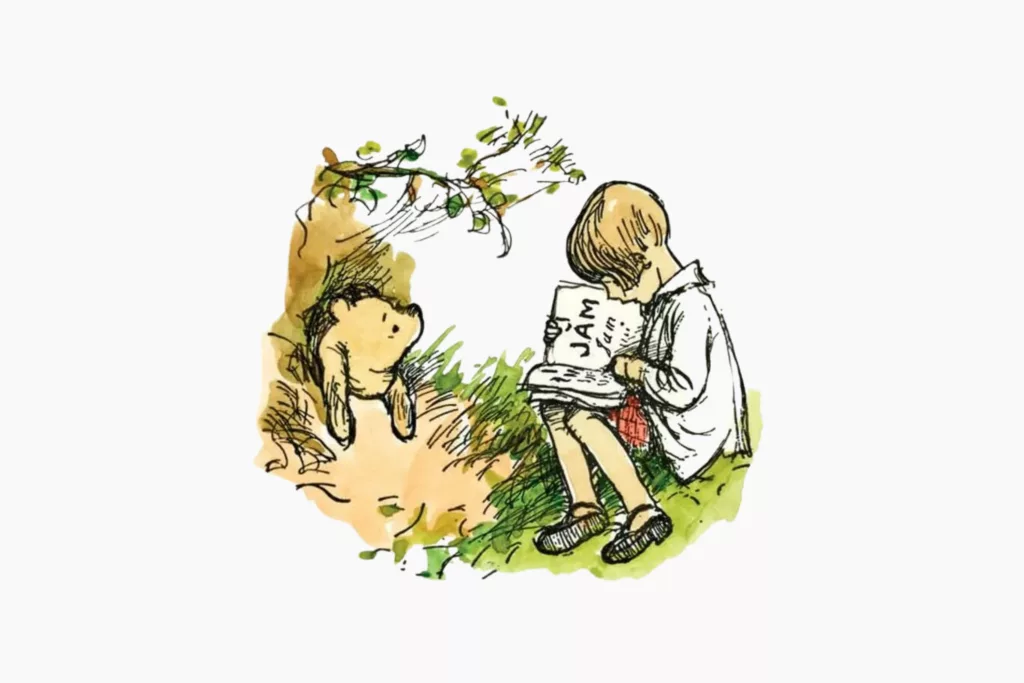
In A A Milne’s Winnie-the-Pooh stories, Christopher Robin reads an alphabet book to Pooh, the bear stuck in a doorway having eaten too much honey. Milne describes it as a ‘sustaining book’: the sort of book that helps a bear in a jam through a difficult situation.
Pooh, of course, was a Bear of Very Little Brain. He was no scholar. Yet Milne understood something profound: books sustain us. They help us make sense of ourselves, of one another, and of the world we live in. They provide comfort, perspective and companionship. They make us wiser. And, yes, they make us cleverer too.
This year marks Pooh’s 100th birthday. Westminster School, as Milne’s alma mater and one of the principal beneficiaries of his extraordinary legacy, will celebrate this anniversary in various ways: on the stage, in the concert hall, and at a special Festival of Children’s literature next week. Here, we will welcome London schoolchildren and fantastic authors to celebrate all that is wonderful about reading.
This anniversary comes at an important moment for reading, books, literature and language. There has never been greater enthusiasm for science, technology, engineering and mathematics, nor greater awareness of their importance. The challenges and opportunities of the coming century will demand extraordinary scientific, technical and digital expertise. But these will demand reading too, and people with the appetite and facility to read seriously, deeply and often.
Milne himself could manipulate numbers as well as words. He is regarded as one of the finest pupil mathematicians Westminster School has produced, a subject he went on to study at Trinity College, Cambridge.
His example reminds us that the much-discussed divide between the arts and sciences – the infamous ‘two cultures’ – need not and should not obtain. The ability to follow a complex mathematical proof depends upon many of the same capacities as are required to understand a demanding novel: attention, interpretation, patience and intellectual stamina. The student who reads deeply is not turning away from science and mathematics; more often, they are preparing further to excel in them.
Evidence increasingly supports this holistic view. Cambridge researchers have linked reading to mathematical achievement as well as better mental health. Worryingly, OECD data from more than three-quarters of a million young people suggests that global reading standards among 15-year-olds are now lower than at any point this century. Standards in maths and science are falling too.
If we care about scientific and mathematical excellence, we must also care about reading.
The dawning of the age of widespread artificial intelligence only serves to strengthen the argument. Never before has information been so abundant, nor the temptation to outsource thinking so great. The capacity to absorb information is not the same as the ability to understand, interpret and evaluate it, to make meaning from it, or to distinguish truth from myth. Reading helps young people to concentrate, question and analyse, to distinguish evidence from assertion and truth from convenience. Those skills will become more valuable, not less, as machines become better at producing answers. We need to train ourselves to evaluate their outputs and hold them to account.
Our politicians and policymakers are not wrong in wanting to make the UK a global powerhouse of mathematics and science – those disciplines are both exciting and critical. But this will only happen properly if our children continue to pick up books and immerse themselves in a breadth and depth of words, ideas and stories. They are the foundation stone of our education, and our humanity.
Reading, like a loyal bear, will sustain us for life.
- Original Winnie-the-Pooh illustrations courtesy EH Shepard LLP / The Estate of EH Shepard © EH Shepard LLP / The Estate of EH Shepard.
2026 is the National Year of Reading, a chance for people of all ages across the UK to discover or rediscover a love for books.