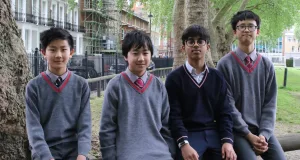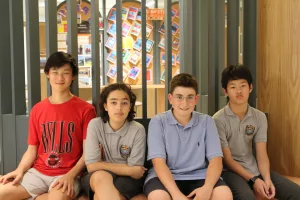
Year 8 pupils have been considering how artificial intelligence could shape their learning and future careers, and the importance of thinking for themselves.
A careers talk with guest speaker Kester Brewin and a recent lesson examining advances in artificial intelligence have prompted Year 8 pupils to consider how AI is changing the way people learn and work.
Kester, a former secondary school teacher and associate director at the Institute for the Future of Work, discussed how inventions from the printing press to computers have changed society. He described an AI system that solved a mathematical problem which had challenged experts for years, prompting pupils to consider the value of working through a problem rather than simply finding the answer.
Year 8 pupil Joshua said: “I believe AI could offer new ways of solving problems, but it could also take away the journey of learning how to solve them. Kester spoke about how AI had solved a problem that had challenged mathematicians for years, but some were unhappy because they valued the process of working towards a solution. I think using AI in this way may pose a threat to human intelligence, but could it also help us in our pursuit of knowledge?”
In a recent AI update lesson, pupils watched Superintelligence, an episode of the BBC Two series The Future with Hannah Fry. The programme examined advances in AI and why some fear that increasingly powerful systems could eventually pose an existential threat.
Mr Oliver Campball-Smith, who organised the sessions, said: “AI is one of the defining issues of our time. The speed and scale of change make it important to give the whole year group time to reflect. Kester’s talk and Hannah Fry’s programme gave us two perspectives on a question adults face too: how can AI help us think more deeply, and what might we lose if we allow it to do the thinking for us?”
The discussions follow a creative writing workshop with Dr Rebecca Mace from the University of Worcester. The workshop explored whether AI could write a masterpiece and what makes writing meaningful. Ayaan said:
“AI writing is simply our writing, albeit on a larger database, so I think my writing will always be more original, more human, which I think is the most important thing in the radically changing world of AI.”
Ethan also said: “AI can only write variations – a mix of what it has seen before, so using your own creativity will always make you more unique than AI.”
Ayaan warned: “The risks of AI are in the form of its sentence, and how it can give false information, which can be misleading, so should always be used in pair with the most important tool you have, your brain.”
These sessions form part of the school’s considered approach to digital technology in teaching and learning. Rather than focusing simply on what generative AI can do, pupils are encouraged to examine its potential benefits and limitations, question the information it produces and consider when, and under what appropriately supervised conditions, such tools might support learning.